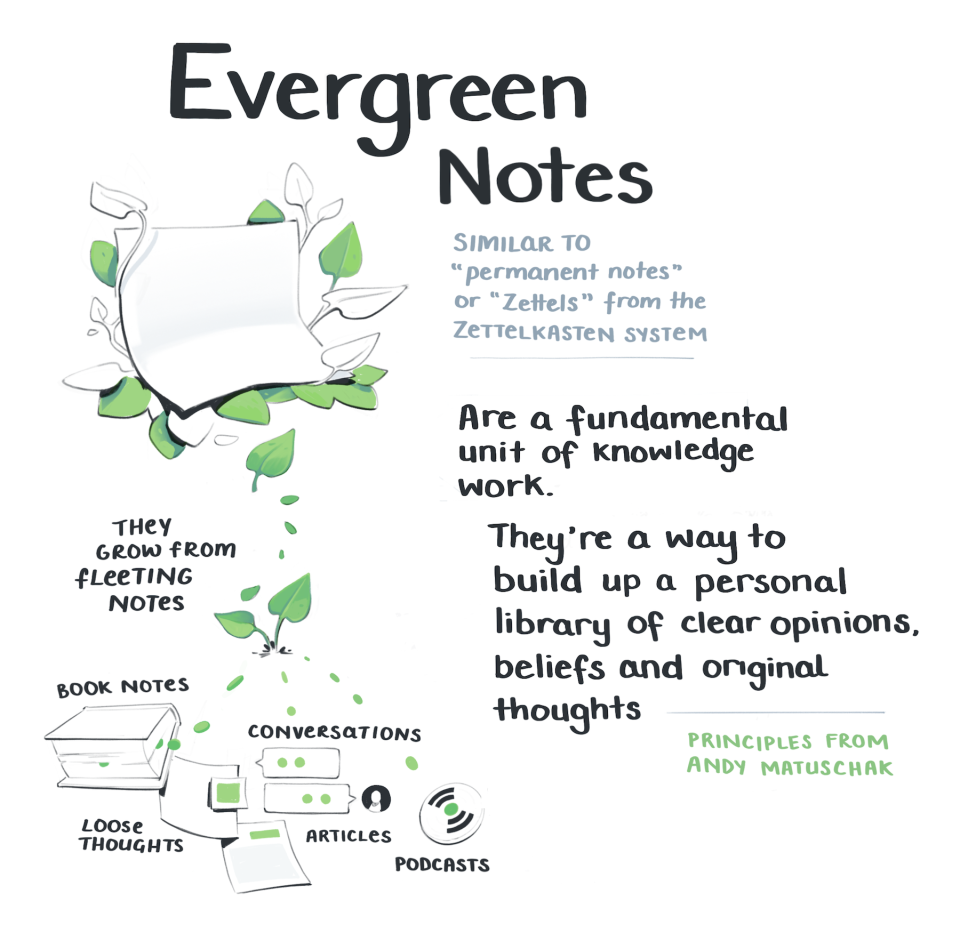
What are evergreen notes?
Seems to be first described by Andy Matuschak, Evergreen notes are said to be fundamental unit of knowledge work.
The concept draws its origins from the Zettelkasten method and is a way to achieve a better note-taking practice and leverage more from your notes than the typical anarchic way of note taking (hear: accumulating notes with no purpose, called “transient notes”).
Evergreen notes are written and organized to evolve over time, hence the name “evergreen” and follow design principles (see Software design principles applied to digital gardening i.e):
- Atomicity: notes should be atomic to allow reuse
- Concept-orientation: notes should be around concepts and big ideas rather than specific things (books, articles, medias…)
- High density linking: notes should be densely connected to other to create better and organic associations rather than strict hierarchical structures.
- Focus on your own ideas rather than others’ ideas: notes should be about your own idea and way to think about the concept you’re writing, rather than a collection of references from books or citations
I’ll kindly add these other concept that I think relevant:
- Personnalisation: notes should be optimised for you rather than for a specific audience or target (but still presentable to a foreign reader)
- Medium diversity: notes should be filled with diverse mediums, like images, audio, video, books, articles, illlustrations, websites, links etc…
- Open-ended: it’s the key principle behind evergreen concept, notes should always be open to extensions
I like how Maggie Appleton illustrated it (from her article Growing the Evergreens)